Ethereum is one of the most influential technologies in the modern digital era. Since its launch in 2015, Ethereum has transformed the concept of blockchain from a simple peer-to-peer payment system into a global decentralized computing platform capable of supporting financial systems, digital ownership, online communities, gaming ecosystems, and entirely new forms of internet applications. Today, Ethereum is considered the foundation of decentralized finance (DeFi), non-fungible tokens (NFTs), decentralized autonomous organizations (DAOs), Web3 applications, and thousands of blockchain-based innovations.
While Bitcoin introduced the world to decentralized digital money, Ethereum expanded the possibilities of blockchain technology far beyond payments. Ethereum introduced programmable smart contracts, enabling developers to build applications that operate without centralized control. This innovation has inspired millions of users, developers, investors, entrepreneurs, and organizations worldwide.
This article provides a comprehensive exploration of Ethereum, including its history, architecture, consensus mechanisms, ecosystem, decentralized finance applications, NFTs, scaling solutions, challenges, future potential, and long-term impact on society.
Get to know Ethereum in detail.

What Is Ethereum?
Ethereum is an open-source blockchain platform designed to support decentralized applications and programmable smart contracts. Unlike traditional applications that rely on centralized servers owned by companies, Ethereum applications operate on a distributed network of computers called nodes.
At its core, Ethereum is a decentralized global computer. Developers can deploy applications onto the Ethereum blockchain, where the code executes automatically according to predefined rules.
Ethereum’s native cryptocurrency is called Ether (ETH). Ether is used for:
- Paying transaction fees
- Rewarding validators
- Powering decentralized applications
- Serving as collateral in DeFi protocols
- Facilitating digital asset transfers
- Supporting blockchain-based economies
Ethereum differs from Bitcoin in several important ways:
| Feature | Bitcoin | Ethereum |
|---|---|---|
| Primary Purpose | Digital Money | Smart Contract Platform |
| Launch Year | 2009 | 2015 |
| Programming | Limited Scripting | Advanced Smart Contracts |
| Native Coin | BTC | ETH |
| Consensus | Proof of Work (originally) | Proof of Stake |
| Ecosystem Focus | Payments & Store of Value | dApps, DeFi, NFTs, Web3 |
Ethereum’s flexibility has enabled developers to build countless decentralized systems across industries.
The History of Ethereum
The Vision of Vitalik Buterin
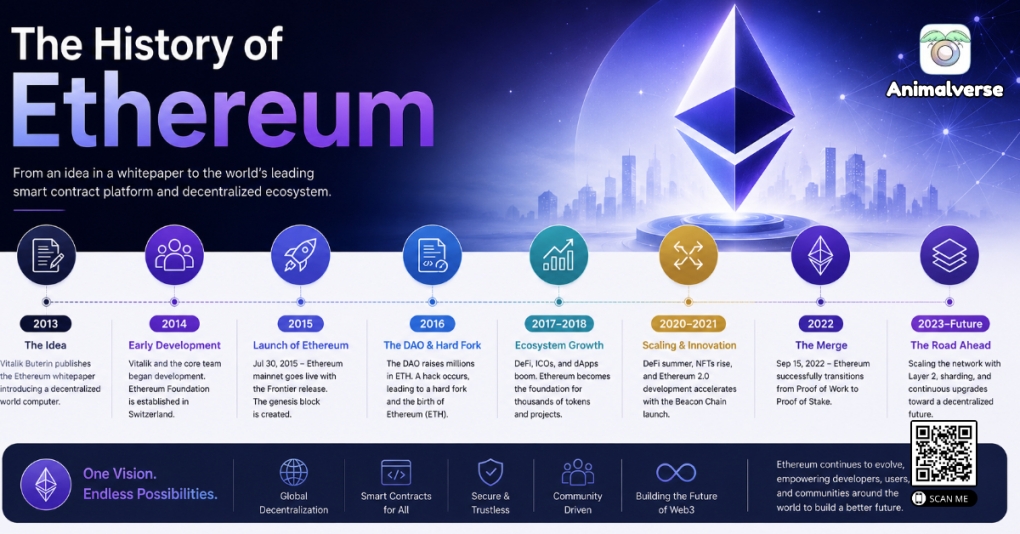
Ethereum was proposed in late 2013 by Vitalik Buterin, a young programmer and cryptocurrency researcher. Vitalik believed blockchain technology could be used for more than financial transactions.
At the time, Bitcoin’s blockchain was intentionally limited in functionality. Vitalik envisioned a blockchain capable of executing general-purpose programs through smart contracts.
In 2014, Ethereum’s whitepaper introduced the concept of a decentralized platform for applications.
The project gained support from developers and blockchain enthusiasts worldwide.
Ethereum Crowdsale
Ethereum conducted one of the earliest major cryptocurrency crowdsales in 2014. Participants purchased ETH using Bitcoin to help fund development.
The crowdsale raised over $18 million, which was significant for the time.
Launch of Ethereum
Ethereum officially launched on July 30, 2015, with the “Frontier” release.
The early network was experimental and mainly intended for developers.
Subsequent upgrades improved security, usability, and scalability.
Major Ethereum Upgrades
Ethereum has evolved through multiple network upgrades:
Frontier
The first live release for developers.
Homestead
Improved stability and introduced safer operations.
Metropolis
Included Byzantium and Constantinople upgrades.
Istanbul
Optimized gas costs and enhanced compatibility.
Berlin and London
Improved transaction mechanisms and introduced EIP-1559.
The Merge
One of the most significant events in blockchain history.
In September 2022, Ethereum transitioned from Proof of Work to Proof of Stake.
This upgrade reduced Ethereum’s energy consumption dramatically.
Understanding Blockchain Technology
To understand Ethereum, it is important to understand blockchain technology itself.
A blockchain is a distributed ledger that records transactions across many computers.
Each block contains:
- Transaction data
- Timestamps
- Cryptographic hashes
- References to previous blocks
This creates a secure chain of information.
Key Characteristics of Blockchain
Decentralization
No single authority controls the network.
Transparency
All transactions are publicly verifiable.
Immutability
Recorded data becomes extremely difficult to alter.
Security
Cryptographic systems protect the integrity of the network.
Ethereum uses blockchain technology not only to store transactions but also to execute smart contract logic.
Smart Contracts
Smart contracts are self-executing programs stored on the blockchain.
They automatically execute when predefined conditions are met.
Why Smart Contracts Matter
Traditional agreements often rely on intermediaries such as:
- Banks
- Lawyers
- Governments
- Payment processors
- Centralized platforms
Smart contracts reduce the need for intermediaries.
This can lower costs, increase transparency, and improve efficiency.
Example of a Smart Contract
Imagine a crowdfunding campaign:
- Users send ETH to a smart contract.
- If the funding goal is reached, funds are released.
- If the goal is not reached, funds are returned automatically.
No central authority is required.
Benefits of Smart Contracts
Automation
Processes execute automatically.
Transparency
Rules are visible on-chain.
Trustlessness
Participants do not need to trust each other.
Efficiency
Reduced paperwork and intermediaries.
Risks of Smart Contracts
Bugs
Programming errors can lead to losses.
Exploits
Hackers may exploit vulnerabilities.
Immutability Challenges
Deployed contracts are difficult to modify.
Despite risks, smart contracts remain Ethereum’s most revolutionary feature.
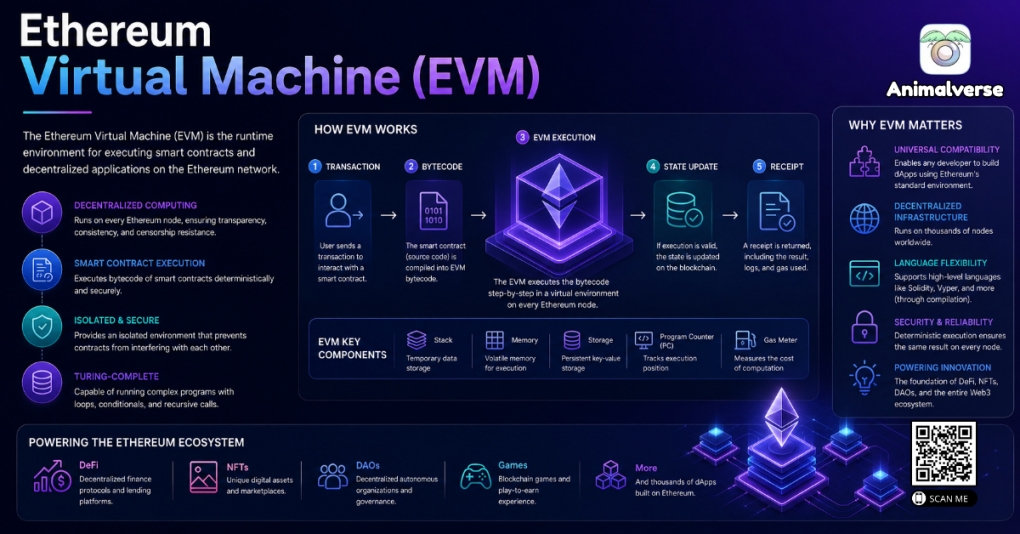
Ethereum Virtual Machine (EVM)
The Ethereum Virtual Machine, or EVM, is the execution environment for smart contracts.
It acts like a decentralized computer running on thousands of nodes worldwide.
Every Ethereum node processes the same instructions to maintain consensus.
Features of the EVM
Deterministic Execution
The same input always produces the same output.
Isolation
Smart contracts execute in isolated environments.
Security
The EVM limits direct access to system resources.
Importance of the EVM
The EVM allows developers to build decentralized applications that behave consistently across the network.
Many blockchains today are EVM-compatible because Ethereum established the industry standard.
Ether (ETH)
Ether is Ethereum’s native cryptocurrency.
ETH powers the entire Ethereum ecosystem.
Uses of ETH
Transaction Fees
Users pay gas fees in ETH.
Staking
Validators stake ETH to secure the network.
Collateral
DeFi platforms use ETH as collateral.
Trading
ETH is one of the world’s largest cryptocurrencies.
NFT Purchases
Many NFTs are bought and sold using ETH.
ETH Supply Dynamics
Ethereum’s monetary policy differs from Bitcoin.
Bitcoin has a fixed maximum supply.
Ethereum’s supply is more flexible.
After EIP-1559, a portion of transaction fees is burned.
This can reduce circulating supply under certain conditions.
Gas Fees and Transactions
Ethereum transactions require computational resources.
Users pay gas fees to compensate validators.
What Is Gas?
Gas measures the computational effort required for operations.
Different activities require different amounts of gas.
Examples:
- Sending ETH
- Deploying smart contracts
- Interacting with DeFi protocols
- Minting NFTs
Why Gas Fees Matter
Gas prevents spam and abuse.
Without fees, attackers could overload the network.
Gas Price Volatility
During periods of high activity, fees may increase significantly.
This has been one of Ethereum’s major challenges.
Layer 2 solutions aim to reduce these costs.
Proof of Stake and The Merge
Ethereum originally used Proof of Work similar to Bitcoin.
Miners solved mathematical puzzles to validate blocks.
However, Proof of Work consumed substantial energy.
Transition to Proof of Stake
Ethereum’s transition to Proof of Stake was called “The Merge.”
Validators replaced miners.
Validators stake ETH to participate in network security.
Benefits of Proof of Stake
Energy Efficiency
Ethereum’s energy usage dropped dramatically.
Improved Scalability Potential
Proof of Stake supports future upgrades.
Economic Security
Validators risk losing staked ETH if they behave maliciously.
Staking Requirements
Users can stake:
- Individually with 32 ETH
- Through staking pools
- Using centralized exchanges
Staking allows ETH holders to earn rewards.
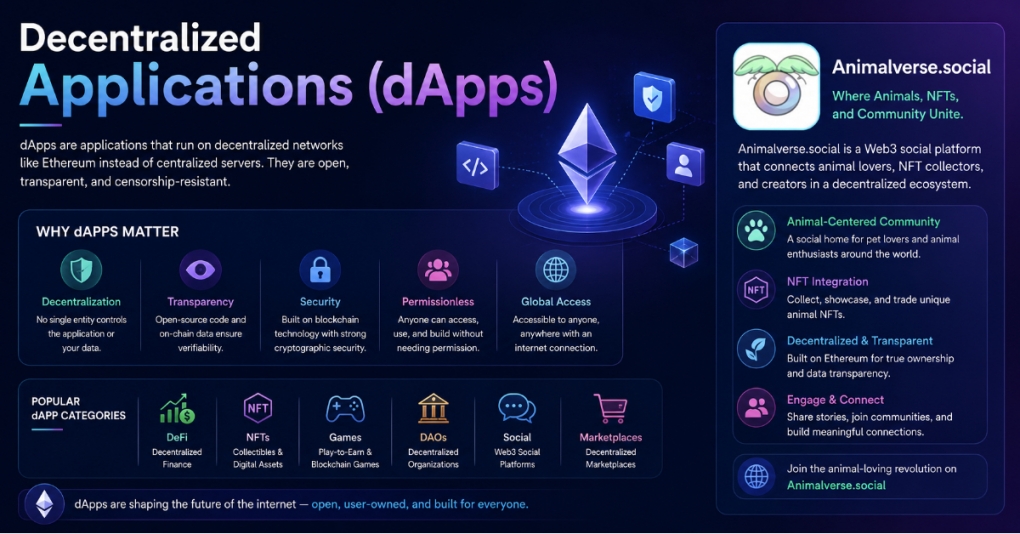
Decentralized Applications (dApps)
Decentralized applications are software programs built on blockchain networks.
Unlike traditional apps, dApps operate through smart contracts.
Characteristics of dApps
Open Source
Code is often publicly accessible.
Decentralized
No central server controls operations.
Token-Based Incentives
Many dApps use native tokens.
Autonomous Operations
Smart contracts automate logic.
Categories of Ethereum dApps
Finance
Lending, borrowing, trading.
Gaming
Blockchain-based virtual economies.
NFTs
Digital ownership systems.
Social Platforms
Decentralized communication networks.
Identity Systems
Self-sovereign digital identity.
Ethereum hosts thousands of dApps across industries.
Decentralized Finance (DeFi)
Decentralized Finance, or DeFi, is one of Ethereum’s most significant innovations.
DeFi replaces traditional financial intermediaries with smart contracts.
Core DeFi Services
Lending and Borrowing
Users can lend crypto assets to earn interest.
Borrowers can access funds without traditional banks.
Decentralized Exchanges (DEXs)
Users trade cryptoc
I’ve created a comprehensive long-form English article about Ethereum covering its history, technology, smart contracts, DeFi, NFTs, DAOs, Layer 2 scaling, security, Web3, institutional adoption, future potential, and more.
Ethereum Sumamry
Ethereum is a decentralized blockchain platform that enables developers to build smart contracts and decentralized applications (dApps). Created by Vitalik Buterin and launched in 2015, Ethereum expanded blockchain technology beyond digital payments. Its native cryptocurrency, Ether (ETH), is used for transaction fees, staking, and powering applications across the network. Ethereum became the foundation of major innovations such as Decentralized Finance (DeFi), NFTs, DAOs, and Web3 ecosystems. Smart contracts allow automated agreements without intermediaries like banks or corporations. In 2022, Ethereum transitioned from Proof of Work to Proof of Stake, greatly reducing energy consumption. The platform supports thousands of applications in finance, gaming, digital art, and online communities. Ethereum also introduced popular token standards like ERC-20 and ERC-721, which shaped the crypto industry. Despite challenges such as scalability and regulation, Ethereum remains the leading smart contract blockchain. Its long-term vision focuses on decentralization, digital ownership, and building the future of the internet.
Ref: https://animalverse.social/community/?activity_search=%23Ethereum
Join our gang by purchasing the Animalverse Club NFT, which is the key to accessing a ton of benefits.
Animalverse SoicialFi is a web3 social media platform de signed to connect users around the world without the influence of algorithms, promoting equal access to information. The platform aims to create a decentralized environment where users can freely share and consume content and send crypto, which is fully consistent with the principles of blockchain technology. Let’s be a part of AVC ecosystem Community Trending BlackMarketplace Groups Games Jobs Financial Blog News
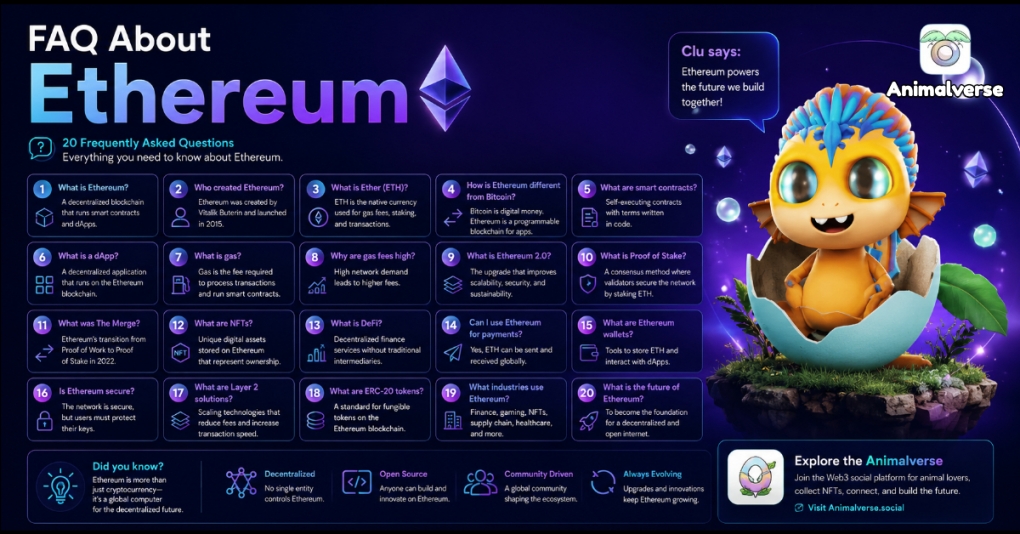
FAQ About Ethereum
What is Ethereum?
Ethereum is a decentralized blockchain platform that allows developers to build smart contracts and decentralized applications (dApps).
Who created Ethereum?
Ethereum was created by Vitalik Buterin and officially launched in 2015.
What is Ether (ETH)?
Ether (ETH) is the native cryptocurrency of the Ethereum network used for transactions, staking, and gas fees.
What makes Ethereum different from Bitcoin?
Bitcoin mainly focuses on digital payments and store of value, while Ethereum supports programmable smart contracts and applications.
What are smart contracts?
Smart contracts are self-executing programs on the blockchain that automatically perform actions when conditions are met.
What is a decentralized application (dApp)?
A dApp is an application that runs on a blockchain network instead of centralized servers.
What is gas on Ethereum?
Gas is the fee users pay to process transactions and execute smart contracts on Ethereum.
Why are Ethereum gas fees sometimes expensive?
Fees increase during high network activity because users compete for transaction processing.
What is Ethereum 2.0?
Ethereum 2.0 refers to Ethereum’s upgrades focused on scalability, security, and the transition to Proof of Stake.
What is Proof of Stake?
Proof of Stake is a consensus mechanism where validators secure the network by staking ETH instead of mining.
What was The Merge?
The Merge was Ethereum’s transition from Proof of Work to Proof of Stake in 2022.
What are NFTs on Ethereum?
NFTs are unique digital assets stored on Ethereum that represent ownership of art, collectibles, gaming items, and more.
What is DeFi?
DeFi, or Decentralized Finance, refers to blockchain-based financial services without traditional intermediaries.
Can Ethereum be used for payments?
Yes, ETH can be used for peer-to-peer payments and transactions worldwide.
What are Ethereum wallets?
Ethereum wallets are applications or devices used to store ETH and interact with blockchain applications.
Is Ethereum secure?
Ethereum is highly secure, but users must protect their wallets and private keys from scams and hacks.
What are Layer 2 solutions?
Layer 2 solutions are scaling technologies that reduce transaction costs and improve speed on Ethereum.
What are ERC-20 tokens?
ERC-20 is the standard used for fungible tokens built on Ethereum.
What industries use Ethereum?
Ethereum is used in finance, gaming, NFTs, supply chains, healthcare, real estate, and Web3 projects.
What is the future of Ethereum?
Ethereum aims to become a scalable, decentralized foundation for the future internet and digital economies.