
Crypto Whale Data
@0x1d7a9641dcccfe07c722bede8b3c2221cc19d4ca
'Don't rush anything': Vitalik Buterin warns against hasty wallet migrations amid growing AI threats
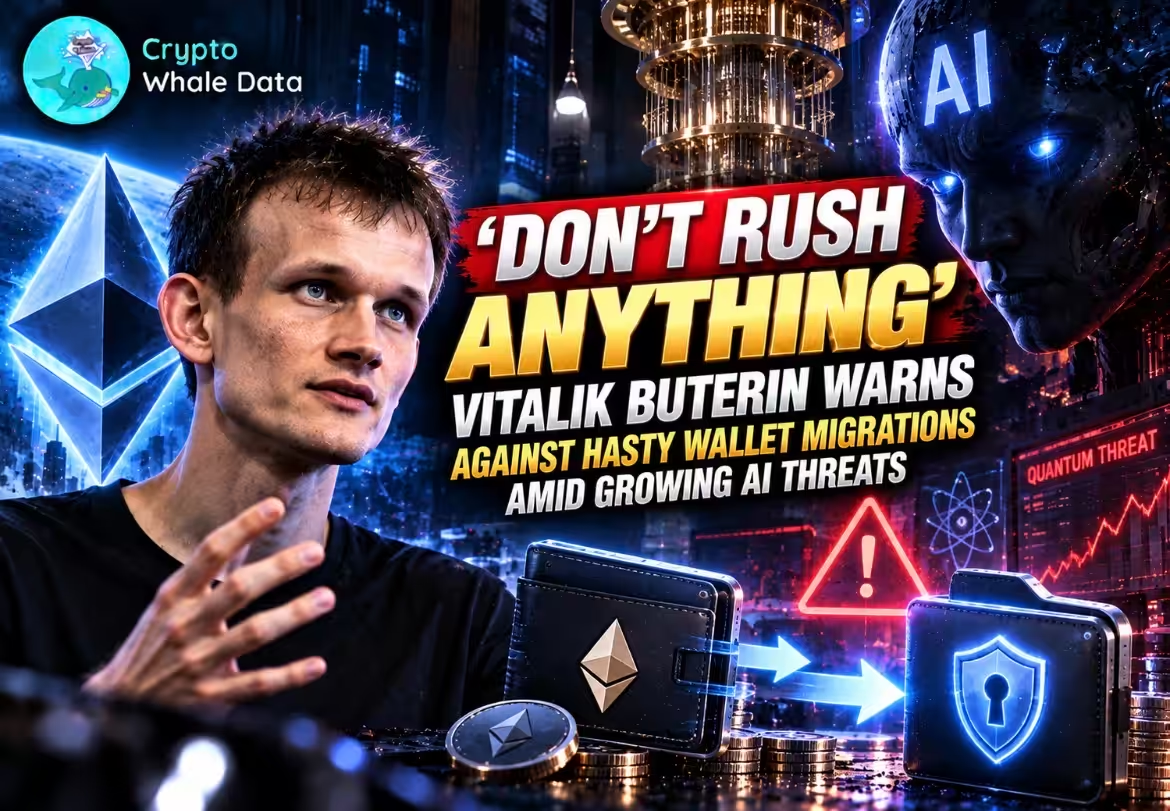
Ethereum co-founder Vitalik Buterin warned that the crypto industry should take risks to cryptography from AI-accelerated math seriously.
Ethereum co-founder Vitalik Buterin warned that the crypto industry should take risks to cryptography from AI-accelerated math seriously, but cautioned against rushing to move funds to new wallets.
In a Wednesday post on X, Buterin said he does not recommend scrambling to move funds to new wallets. While keeping assets in addresses that have never signed a transaction is a good precaution if the move is easy, he noted that botched migrations have cost him more than hacks.
Buterin's comments came in response to an earlier post from Ethereum Foundation researcher Justin Drake, who called on the industry to start planning for what he described as "bunker mode."
Drake said that the Elliptic Curve Digital Signature Algorithm (ECDSA) could potentially be broken before "q-day," when quantum computers become powerful enough to break widely used public-key cryptography. In a worst-case scenario, he said, such a breakthrough could occur within months rather than years.
Drake recommended moving funds in a controlled way to fresh addresses that keep their public keys hidden, while warning holders not to panic or rush.
Rising threat
Buterin noted that AI-accelerated math is a key reason ECDSA could fall faster than expected. Most planning, he said, has assumed "elliptic curves broken, hashes safe, lattices safe."
The Ethereum founder said there is a good chance the concrete security of lattices "will take serious hits from the next two years of AI math." He named ML-DSA, fully homomorphic encryption, and lattice schemes as the core area of risk.
The warnings come amid rapid advances in AI-generated mathematics. On Tuesday, OpenAI published hundreds of mathematical manuscripts produced by an internal model — a development Drake described as evidence that "mathematical superintelligence is upon us."
Buterin said that the industry should be more conservative on lattice parameters and prefer hash-based constructions where they are possible.
"For privacy protocols, strongly favor not putting encrypted notes onchain. Instead, send them offchain through some third-party mechanism," Buterin said.
Despite the potential risks, Buterin reiterated that holders should avoid making hasty moves.
"[It's] very easy to lose funds from a misconfigured rushed upgrade, so ... don't rush anything," he added


'Don't rush anything': Vitalik Buterin warns against hasty wallet migrations amid growing AI threats Ethereum co-founder Vitalik Buterin warned that the crypto industry should take risks to cryptography from AI-accelerated math seriously. Ethereum co-founder Vitalik Buterin warned that the crypto industry should take risks to cryptography from AI-accelerated math seriously, but cautioned against rushing to move funds to new wallets. In a Wednesday post on X, Buterin said he does not recommend scrambling to move funds to new wallets. While keeping assets in addresses that have never signed a transaction is a good precaution if the move is easy, he noted that botched migrations have cost him more than hacks. Buterin's comments came in response to an earlier post from Ethereum Foundation researcher Justin Drake, who called on the industry to start planning for what he described as "bunker mode." Drake said that the Elliptic Curve Digital Signature Algorithm (ECDSA) could potentially be broken before "q-day," when quantum computers become powerful enough to break widely used public-key cryptography. In a worst-case scenario, he said, such a breakthrough could occur within months rather than years. Drake recommended moving funds in a controlled way to fresh addresses that keep their public keys hidden, while warning holders not to panic or rush. Rising threat Buterin noted that AI-accelerated math is a key reason ECDSA could fall faster than expected. Most planning, he said, has assumed "elliptic curves broken, hashes safe, lattices safe." The Ethereum founder said there is a good chance the concrete security of lattices "will take serious hits from the next two years of AI math." He named ML-DSA, fully homomorphic encryption, and lattice schemes as the core area of risk. The warnings come amid rapid advances in AI-generated mathematics. On Tuesday, OpenAI published hundreds of mathematical manuscripts produced by an internal model — a development Drake described as evidence that "mathematical superintelligence is upon us." Buterin said that the industry should be more conservative on lattice parameters and prefer hash-based constructions where they are possible. "For privacy protocols, strongly favor not putting encrypted notes onchain. Instead, send them offchain through some third-party mechanism," Buterin said. Despite the potential risks, Buterin reiterated that holders should avoid making hasty moves. "[It's] very easy to lose funds from a misconfigured rushed upgrade, so … don't rush anything," he added. Ref: https://paykalken.com #VitalikButerin #Ethereum #ETH #ArtificialIntelligence #CryptoSecurity #QuantumComputing #Cryptography #CryptoWallet #BlockchainSecurity #CryptoNews